Sunday, 27 January 2013

Continuity Editing

Continuity editing is known as the "invisible art", meaning that the audience don't notice a cut has been made. But it can be deliberate for example:

  • when talking to a camera (breaking the 4th wall) 
  • fancy edits- unrealistic
  • no sense editing
A rule of continuity editing is the 180 degree rule this is when the camera can only move around the 180 degree angle around the people talking and cannot break it. When it's broken it can confuse the audience. 
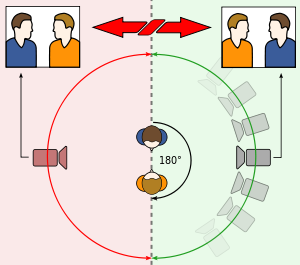
Another technique used is shot reverse shot, this is where the camera cuts from one subject to another, this is normally done when filming of people talking. We used this technique often in the 'Oceans 12' task we were given, instead of zooming out as we thought it would be more interesting to see the facial expressions of the actors close up.
Match on action is also used, this is done when something happens in the scene then there is a cut to the action that must be going on. 
Cross cutting is where it alternates between shots occurring simultaneously in two or more different locations. We used this technique when we were trying to create the spooks storyboard.
Eyeline match is a cut between two shots, where the first person is looking in one direction, and then in the next shot we either see what the person is looking at or another person looking back in the exacts same direction.  

In continuity editing an establishing shots are used, this is done to show where it is, what time it is and who's in the scene-spatial relations between important characters.

Graphic match is where the scene cuts from A to B using objects that have the same shape. For example in The Mummy there is a literal shape match used.


Oceans 12


Our task we to change the camera shots of a sequence from Oceans 12, we added more close up and over the shoulder shots for when the actors were speaking. By doing this it can help organise what shots we want to do to beforehand,helping make the filming process easier.

Spooks Storyboard


This is the order we thought the shots might go in. When we watched the actual sequence we found we weren't that far off, however we saw our order didn't make sense. This will help us through the filming and editing process as we now know the importance of continuity editing and how important it is for the audience to understand the sequence.

Max Payne Analysis

Shot Number
Technical sound description
Effects on meaning/ sound
1
Sound motif, orchestral
Recognisable- audience is familiar with the company so they believe the film will be good
2
Sound bridge, dark, non-diegetic, voice over
Makes the words more powerful and meaningful as nothing on screen so makes audience more engaged. Mysterious.
3
On screen diegetic, rising
Makes audience jump- visceral pleasure. Unexpected sound suddenly comes on.
4/5
Foley track, on screen diegetic
Water is really loud- emphasises he is struggling, no music in background so we can hear him deep breathing really loudly.
6
Non diegetic, parallel
Only hear water suggests that the man is going to die, we can hear what he can hear in the film.
7
Voice over, off screen diegetic.
Voice goes well over the sound of the water which makes it scarier, serious voice.
8/9
Menacing, ominous, non-diegetic, sound bridge
Hear baby crying in background, hear clock ticking every time he takes a step could be his memories and we can still hear water which tells the audience that he is still under water.
10
Voice over, non diegetic, no music- silence
No music only him talking and the water in the background this makes it more serious.
11
Ominous, rising (door), repetitive
Hear door open- makes audience expect something to happen. Clock starts ticking again which suggests that his time is up.
12
Sound bridge, non diegetic , rising
Still hear water and clock ticking but a child’s toy has been added- more tense and could suggest his memories.
13
Non diegetic, rising
Clock has become really loud which emphasises the point that his time is nearly over.
14
On screen diegetic, eerie
Finally see the child’s toy we have been hearing so the audience are given another clue to what is going on.
15
Sound bridge, voice over, non diegetic
Hear him speaking again but no image which implies everything has ended .Hear sirens in the background suggests that it is either before or after he died.
16
Non diegetic, on screen diegetic
The audience are fully engaged and now want to know what happens. Shown where it is set and time, beginning of story.


This task will help when choosing the sound for our opening sequence, as this sequence I analysed, I found the sound was the key thing that appealed to the audience. 

Class Act


Friday, 25 January 2013

25/1/13

Today in the lesson we found it hard to decide where to cut as we realised that the props in the shot were different, for example Mary was holding her phone in different hands in each shot. Because of this we decided that we will need to re shoot the whole of the kitchen scene.
Also today we were supposed to film the park scene however we had some problems with the person we were going to use and so it was too dark to film. We re scheduled it to next Saturday.

Thursday, 24 January 2013

24/1/13

Today in the lesson we found that the editing we had done for the kitchen seen was lost. This was because we hadn't saved it correctly, but now we know how to save so that the files aren't corrupt. We had to redo the editing we had already previously done.